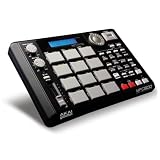
 This is my first mpc purchase. I've had my mpc 500 for a little over a month now and i am loving it. Truth be told, don't be fooled by its small design. It is a monster with a lot of potential IF you take the time to really read the manual and get to know it. Once you do, trimming and adding effects is a piece of cake.
 First the pros: It's got a solid design and is very sturdy.It has the same sampling rate (44.1 kHz) as other mpc's in the lineup. By far the biggest advantage is that its portable. You pop in the batteries and boom.Finally, its compatible with other mpc's so moving your work from one to another is not hard at all.
The cons: the mpc 500's portable design is also its biggest weakness. If you are a beginner looking to get your first mpc, I would not recommend getting this. I got it because it was the cheapest mpc in the lineup but its small design limits its RAM. The mpc 500 only comes with 16MB of RAM (which can be upgraded to 128MB) so your sampling time is severely limited when compared to other mpc's. Second, you only get a much smaller lcd screen so when it comes to chopping samples you have to do so by numbers (and by ear) rather than seeing an actual waveform on your screen like other mpc's. My personal complaint with the mpc is that AKAI reduced the amp section to make it sleek and small but as a result you get 12dB less output in your recordings. This isn't a major problem but I find myself constantly normalizing AND applying a compressor to most my samples.
Finally, to address the issues raised by the other reviewers, the pads are a little stiff when its right out the box but there are two things to be said. 1) If you've never had an mpc before, the pads are velocity sensitive so if you tap them soft the sound comes out soft, if you strike it hard, the sound comes out louder in order to mimick a real instrument. BUT if you dont like this idea, all you have to do is press the "FULL LEVEL" button and your samples are triggered with a mere tap of the pad.Bottom line: If you are a traveling musician who is on the road alot or if you have other mpc's and/or have extra money to burn, I would recommend getting the mpc 500.If you're looking for an mpc for your home studio the mpc 500 is not a bad deal at all but I would recommend saving up for the mpc 1000 or 2000(XL).
Click Here to see more reviews about: Akai MPC 500 MIDI Production System Sampler
Product Description:
Sample and create music wherever inspiration strikes with the portable Akai MPC500 all-in-one Music Production Center. Whether you travel around the globe or across town, the MPC500 is the ultimate answer to your mobile production needs. It weight just under 3 pounds--a perfect fit for your backpack, messenger bag, or briefcase--and it can be powered for up to 4.5 hours on 6 AA batteries
The MPC500 combines a 48-Track MIDI Sequencer and a 32-voice Stereo Digital Sampler, with 12 velocity and pressure sensitive rubber pads. It comes standard with 16 MB of on-board memory and can be expanded up to 128 MB of RAM. When connected to a Mac or PC via its built-in USB port, you can simply drag and drop data between the computer and the MPC500's CF card.
Roam where you want to with the compact Akai MPC500 (see larger image).
Built-in analog I/O, headphone output, and MIDI in/out (see larger image).
Power with included AC adapter or 6 AA batteries (see larger image).
Key Features
Battery powered (6 AAs) or wall powered (AC adapter included)
Pattern-based 48-track sequencer with 16 MIDI channels
32-voice drum/phrase sampler with up to 128 MB RAM
Velocity and pressure-sensitive pads for responsive, accurate programming
12-level function places one sound on all pads with progressive level or tuning per pad
Compact Flash drive and USB port (Mass Storage Class)
Support for standard WAV files and MIDI sequences
Analog I/O, headphone output, MIDI I/O
Sounds included to get started quickly
Four-way sample layering and velocity switching per pad
Low-pass filter with resonance per voice
On-board effects: two stereo effects and a master effect
Specifications
Storage: Compact Flash: Type-II, support up to 2 GB card
Memory: 16 MB installed (Can be expanded to 128 MB with EXM-128)
Analog Input/Output:
(2) Balanced 1/4-inch Inputs
(2) Unbalanced 1/4-inch Outputs
(1) Headphone Output
MIDI Input/Output:
(1) MIDI Input [5-pin DIN]
(1) MIDI Output [5-pin DIN]
Other Input/Output:
(1) USB [Slave only]
Levels:
Analog Input = +10dBu
Analog Output = +5dBu
Sampler Resolution: 16bit/44.1kHz
Sampler Recording Time:
136 seconds [16 MB/MONO]
24 minutes 28 seconds [128 MB/MONO]
Sequencer Details:
100,000 notes resolving at 96ppq
99 Sequences with total 64 tracks per seq
20 Songs with total 250 steps per song
24 "Active (loaded)" Programs max
Pad Details:
12 (velocity and pressure sensitive)
4 Pad Banks [A, B, C, D]
Power Options:
12V DC 500mA pin-negative power adapter (included)
(6) AA batteries [lasts about 4.5hrs continuous use w/backlight ON]
Dimensions: 10.5 x 1.73 x 6.89 inches (WxHxD)
Weight (net): 2.93 pounds
Data Compatibility:
MPC1000 -- SEQ, WAV, PGM
MPC2000/2000XL -- SEQ (saved as MID file only), WAV, SND, PGM (Most parameters of PGM file can be loaded.)
MPC2500 -- SEQ, WAV, PGM
MPC4000 -- SEQ (saved as MID file only), WAV, AKP (DRUM program only...No Keygroups. Only note assign and tune are loaded.)
MPC3000 -- SND (THRU Computer)
Z4/Z8 -- WAV, PGM (DRUM program only. Only note assign and tune are loaded.)
S5000/6000 -- WAV only (THRU Computer)
S1000/3000 -- No compatibility
Buy cheap Akai MPC 500 MIDI Production System Sampler now Get 58% OFF

0 comments:
Post a Comment